How to catch it before the monthly report
An ecommerce conversion rate usually drops for one of five reasons: a technical problem in the cart or checkout, a new release, a change in where your traffic comes from, a usability problem on a key page, or seasonality. To find which one, check your funnel step by step and segment by segment, as soon as the drop starts.
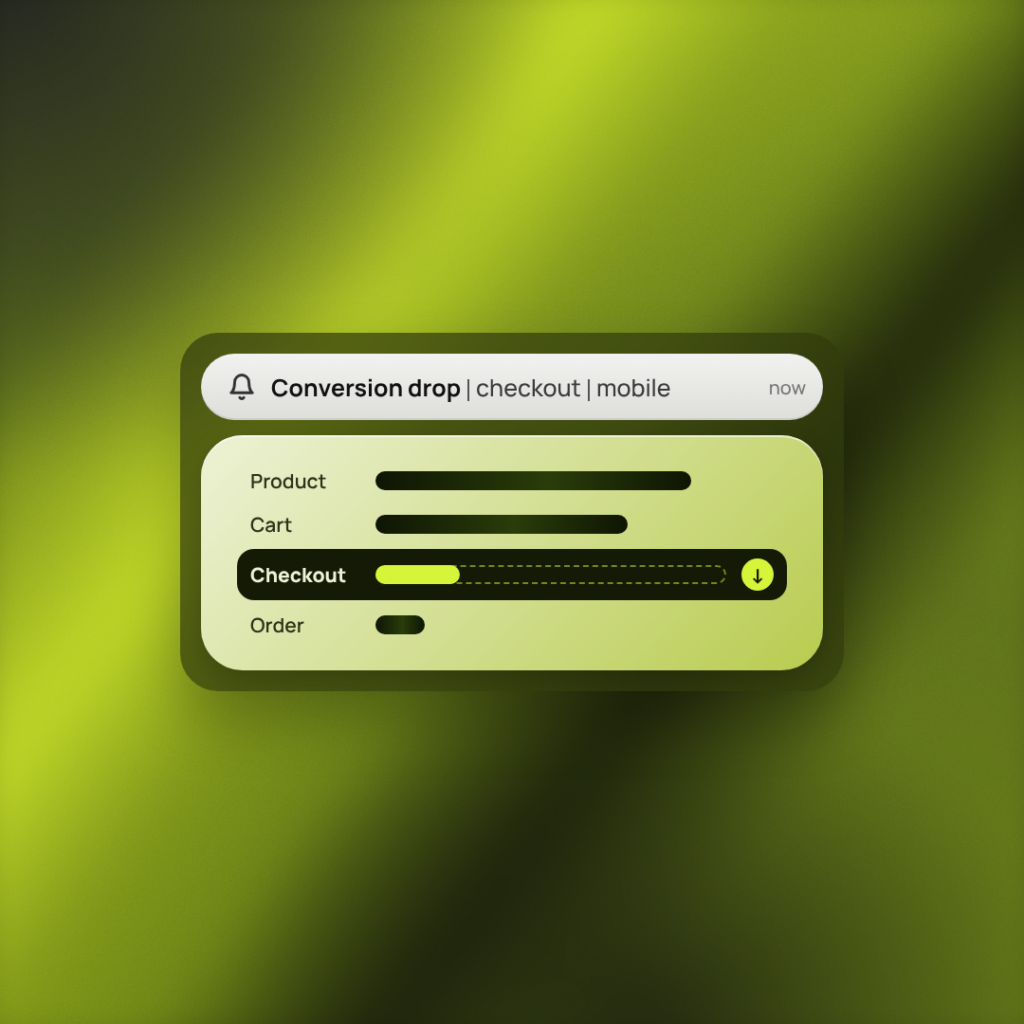
Δelta, the CRO monitoring tool by VALUE, checks your e-shop every 15 minutes, from the cart to the order, and alerts your team when a drop is real, with the step and the segments where it started.
Why is my ecommerce conversion rate dropping?
Look at when the drop started, which funnel step it affects and which visitors it affects. Those three answers usually point to the cause:
| Possible cause | How it shows in the data | Where to check |
|---|---|---|
| Technical problem in cart or checkout | A sudden drop at one step, often on one device or browser, while traffic looks normal | Funnel by device and browser, plus a test order of your own |
| New release or redesign | The drop starts right after a deploy date, on the pages that changed | Before and after the release date |
| Change in traffic mix | Traffic goes up, conversion rate goes down, after a new campaign or channel | Conversion rate by channel and campaign |
| Usability problem | More exits from a key page, repeated clicks on things that do not respond | Behavior on product, cart and checkout pages |
| Seasonality | A similar dip in the same period last year, across all channels | The same weeks of last year |
| Tracking problem | Conversion rate drops in analytics, but orders in your e-shop platform do not | Analytics orders against platform orders |
Keep the focus on the conversion rate itself. Sales can fall because traffic fell, which is a different problem with different fixes.
How do I find where the funnel loses customers?
Split the conversion rate into steps and compare each one with its usual level. A typical e-shop funnel is product page, add to cart, checkout and purchase. If the rate from cart to checkout falls while the other steps stay the same, the problem lives between those two pages.
Then split each step by segment: device, channel, country and page. A drop that shows only on mobile, or only on visitors from one campaign, is much easier to fix than a drop in the total, which can hide it.
How do I know if the drop comes from a new release or redesign?
Compare the funnel before and after the release date, on the pages and devices the release touched. If the drop starts at the release and stays on those pages, the release is the likely cause. If it started earlier, or appears everywhere at once, the timing may be a coincidence.
The same applies to a full redesign or migration. Watching the funnel closely from the first day of the new site lets you catch a broken step before a whole month of sales runs through it. If a new campaign brings clicks but not sales, the creative may be the issue: see how to test ad creatives before launch.
How do I get an alert when the conversion rate drops?
Use monitoring that checks each funnel step on a schedule and alerts you only when a change is unlikely to be chance. A monthly report tells you what happened weeks ago. Checking dashboards by hand depends on someone looking at the right chart on the right day.
The alert should say more than “conversion rate is down”. It should say which step and which segment changed, compared with what, so the team can act the same day instead of starting an investigation.
Which user behavior signals show a problem?
Repeated clicks on a button that does not respond, clicks on elements that are not links, and visitors who leave a page within seconds are early signs of friction. They often show up before the conversion rate falls far enough to notice.
It also matters whether the traffic is real. A wave of bot traffic can make the conversion rate look worse while real customers behave exactly as before.
How does Δelta by VALUE monitor this automatically?
Δelta by VALUE checks every funnel step and every segment every 15 minutes, separates real drops from noise, and sends your team an alert with an explanation of what changed. It finds and explains the problem. The fix is made by your team, or with VALUE’s CRO team, which proposes the next step.
- Funnel and segments. From the cart to the order, by channel, device, country, audience and page, not only the total.
- Releases. A before and after view around every deploy, to show whether a release caused a change or just happened at the same time.
- One explanation. Trends, alerts, funnels, behavior and releases are combined into one story, and you can ask questions about your data in Greek.
How it works. Δelta connects to your GA4 property. You set a baseline period, and every 15 minutes Δelta runs a statistical test (two-proportion z-test, p < 0.01, minimum sample of 200) on each metric and segment. Related alerts are grouped together, so one problem does not arrive as fifty messages, and each alert reaches your Slack channel within minutes with its p-value and sample size. Δelta also tracks behavior signals such as rage clicks, dead clicks and quick-back exits, and separates bot traffic from real users.

Frequently asked questions
How big a drop in conversion rate is abnormal?
There is no single percentage that applies to every e-shop. A small store sees large swings from day to day, while a large one can show a real problem in a small change. A better test is whether the drop is statistically unlikely to be chance, given how many visitors you had at that step.
How do I tell seasonality from a real problem?
Compare the same weeks of last year and look at the shape of the drop. Seasonality tends to affect all channels and steps gradually. A real problem usually starts suddenly, hits one step or one segment harder than the rest, and often lines up with a release or a campaign change.
How do I get notified when my conversion rate drops?
Set up monitoring that checks your funnel steps on a schedule and sends an alert to a channel your team already reads, such as Slack or email. Make sure each alert names the step and the segment affected, so it leads to action rather than to another report.
What signals show a problem in the checkout?
A drop from cart to checkout or from checkout to purchase, especially on one device or browser, is the clearest sign. Repeated clicks on the payment button, error messages and a rise in exits from the checkout page usually confirm it. A test order of your own is the fastest check.
What is the difference between conversion rate and sales?
Conversion rate is the share of visits that end in an order. Sales also depend on how many people visit and how much they spend. Sales can fall while conversion rate holds, if traffic drops, and conversion rate can fall while sales rise, if a campaign brings many less ready visitors.
Find where your e-shop is losing customers
Request an analysis of your e-shop and see where you are losing customers.