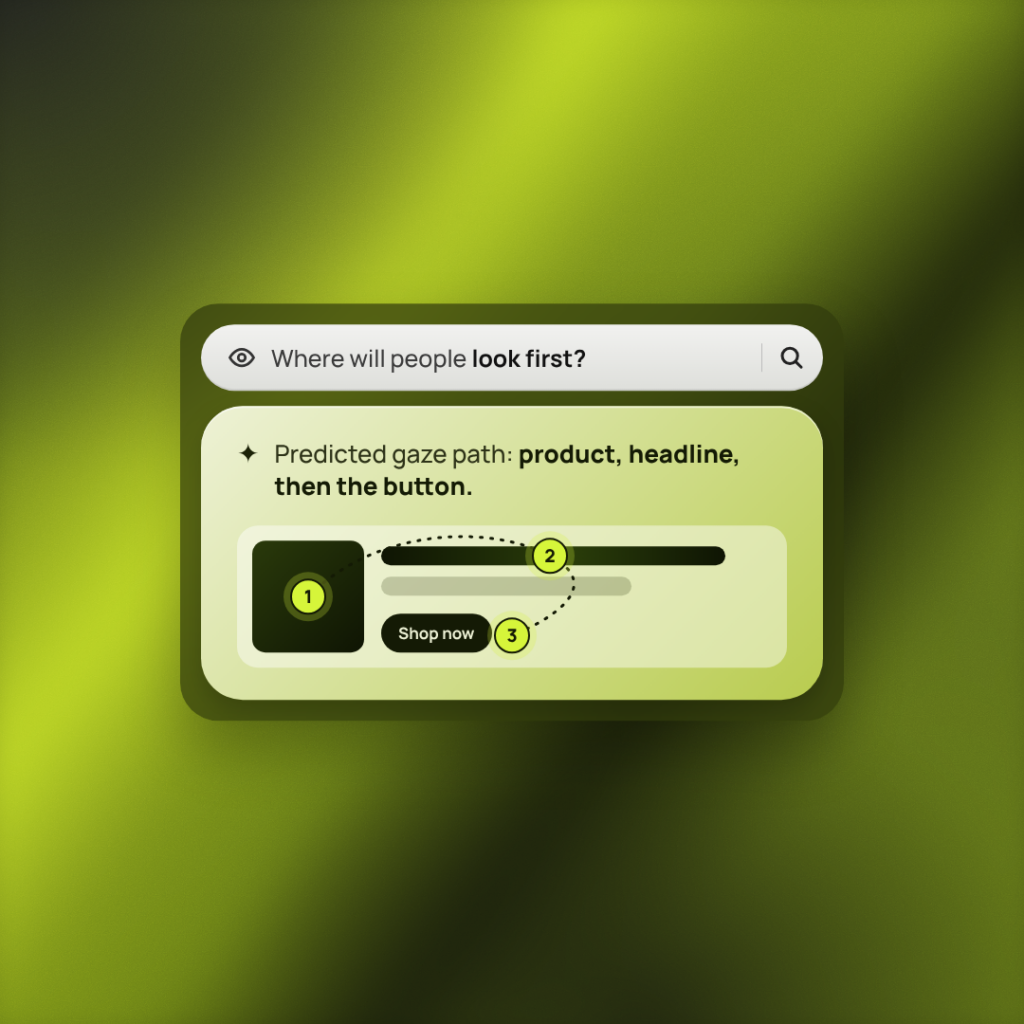
See where your audience will look before you spend
To test ad creatives before launch, run each version through an attention prediction tool, check whether the offer, the product and the call to action get noticed first, fix what gets missed and compare versions. You get the answer before any budget goes to media, not weeks later from a live test.
Glanzz by VALUE is a predictive eye tracking tool. Its own AI shows where people are likely to look first on an ad, a landing page, an email or a package, before it goes live. It was built by VALUE, by the same team that plans and runs campaigns for brands every day.
How do I test an ad creative before launch?
Predict where attention will go, check it against the one thing the ad has to say, then fix and check again. Your team has seen the ad ten times. Your audience will see it once, usually while scrolling, so the question is simple: will they notice what you are paying to show them?
- Decide the one element that must be seen: the offer, the product or the call to action.
- Upload the creative, or paste the URL of the page, into an attention prediction tool.
- Look at the heatmap. Is that element inside the area that gets the most predicted attention?
- Change one thing (size, position, contrast, a face or a background that pulls the eye away) and run it again.
- Compare the versions and keep the one where attention lands on what matters.
- Launch, then confirm with your real campaign data.
What is AI attention prediction?
AI attention prediction estimates where people will look first on a visual, without recruiting anyone to look at it. A model learns from eye tracking data collected in earlier studies and applies that to your creative. Glanzz by VALUE calibrates its scale on data from UEyes, an eye tracking study of web pages, apps and posters.
The result is a prediction, not a measurement of your own audience. That is what makes it fast and cheap enough to use on every version, and it is also why it works best next to live data, not instead of it.
How do I generate an attention heatmap with AI?
Upload an image or paste a URL, and the tool returns a heatmap of predicted attention. With Glanzz by VALUE an analysis takes about two seconds and needs no participants.
Warm areas show where most attention is predicted to go, cool areas show what is likely to be missed. When you read one, check three things: whether the offer or product sits in a warm area, whether a face or a busy background is taking attention away from it, and whether the call to action gets any attention at all.

How do I check if a landing page draws attention where it should?
Run the first screen of the page, the part visitors see before they scroll, and check that the headline, the value proposition and the main button get attention before anything else. If a decorative image or a secondary link takes the most attention, the page is working against you.
Glanzz by VALUE also shows the share of predicted attention on specific elements, such as the logo, the headline, the button or a face. That turns a design discussion into a comparison you can see. What happens after launch matters too: if sales slow down later, our guide on why your ecommerce conversion rate is dropping covers how to find the cause.
How do I improve a creative before I spend budget?
Test the versions before launch and keep the live test for the final decision. Each method answers a different question:
| Lab eye tracking study | Live A/B test | Attention prediction (Glanzz by VALUE) | |
|---|---|---|---|
| When you get the answer | After weeks (recruiting, lab sessions, analysis) | After the campaign has run long enough | In about 2 seconds per creative |
| Cost | Participants, lab time and analysis | Media budget on every version tested | No media budget, no participants |
| What it tells you | Where real participants actually looked | Which version got more clicks or sales | Where attention is predicted to land, and in what order |
| Best for | Deep research on a few key assets | Final proof with real people | Fixing and choosing versions before launch |
In practice: predict and fix before launch, then let the live test confirm the winner. You spend media budget only on versions that already get noticed.
How does Glanzz by VALUE help?
Glanzz by VALUE gives your team a predicted view of attention for every creative before it goes out, and the VALUE team can take it further with analysis, redesign and the campaign itself.
- Every format. Ads, landing pages, emails, packaging, social posts and video.
- Several versions at once. Compare variations side by side and rank them by score.
- Easy to share. Show the result to a client or a manager, instead of arguing about taste.
How it works. Glanzz by VALUE produces four outputs: an attention heatmap, a focus and clarity score from 0 to 100 (how concentrated attention is and how clear the visual hierarchy is), areas of interest (the share of attention on each logo, headline, button or face) and a gaze scanpath (the likely order in which the eye moves). It runs as a web app where you upload an image or paste a URL, as a Figma plugin for frames still in design, and as a Chrome extension for the page you are viewing. All heatmaps and scores are Glanzz's AI estimates, not measured eye tracking.
Frequently asked questions
What is an attention heatmap?
An attention heatmap is a color overlay on a visual that shows where people are likely to look. Warm colors mark the areas that draw the most attention, cool colors mark the areas that are likely to be missed. An AI attention heatmap is predicted from eye tracking data, so you can create one for any ad or page before it goes live.
Can an AI eye tracking tool replace real eye tracking?
No. An AI tool predicts attention, while a real eye tracking study measures how actual participants look at a visual. Prediction is faster and costs far less, so it suits everyday decisions on many versions. A lab study is still the right choice when you need measured behavior from a specific audience.
How reliable are AI attention predictions?
Treat them as an informed estimate. They are built on eye tracking data from earlier studies, so they are useful for spotting a missed offer or comparing two versions. They do not know your audience or your context, so confirm important decisions with live campaign data after launch.
Can I test a landing page or packaging, not just ads?
Yes. Glanzz by VALUE works on ads, landing pages, emails, packaging, social posts and video. For a landing page you can paste the URL. For packaging you upload an image of the design, to see what stands out before it is printed.
What does an attention score show?
In Glanzz by VALUE, the focus score shows how concentrated attention is on one clear point, and the clarity score shows how clear and easy to read the visual hierarchy is. Both run from 0 to 100 and help you rank several versions of the same creative.
See where people will look before you spend
Send us your ad or landing page and see where people will look before you spend your budget.